3–5 March 2026 | Brno, Czech Republic
The Ingr’s Days Conference / Food Symposium 2026 was held in Brno from 3–5 March 2026, bringing together researchers, industry experts, and policymakers working in food science, agricultural innovation, biotechnology, food safety, and sustainable resource management. The symposium served as a multidisciplinary forum for presenting recent scientific developments and strengthening international academic collaboration.
Prof. Ivan Širić presented a poster entitled “Integrated Identification and Characterization of Wild Edible Mushrooms: From Samples to Data.” The presentation outlined a structured framework for accurate species identification and comprehensive safety assessment of wild edible mushrooms. He explained the importance of integrating morphological observations with molecular tools, biochemical profiling, and environmental analyses to achieve reliable taxonomic verification.
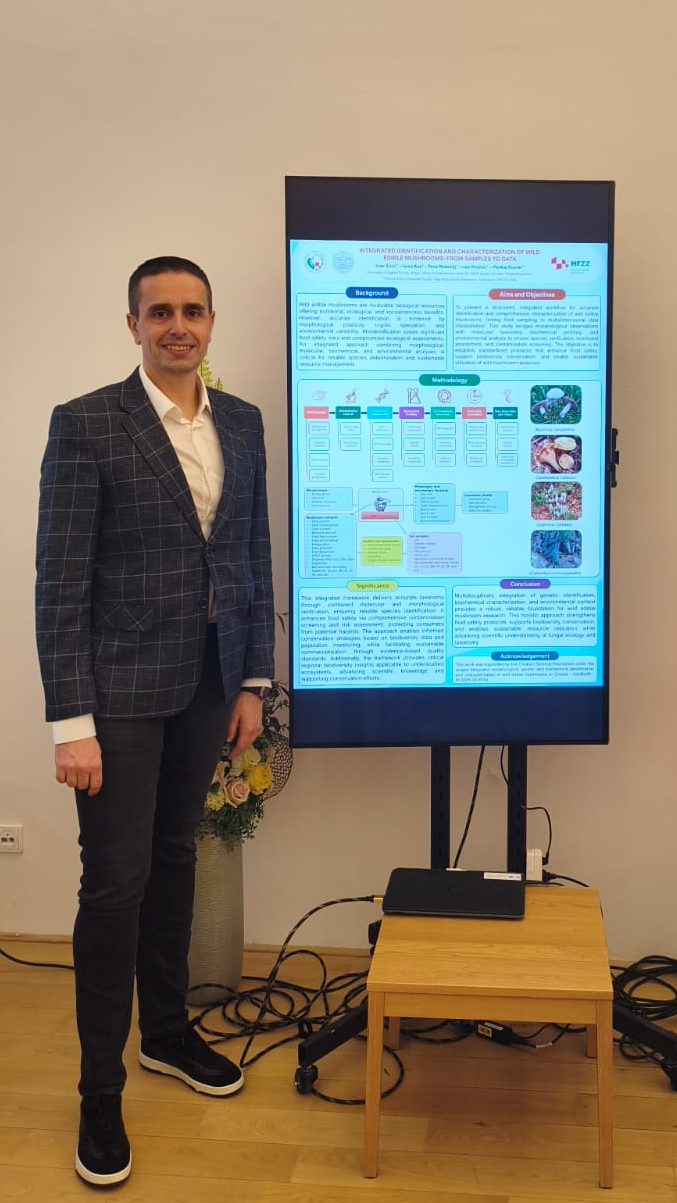
Prof. Ivan Širić presenting the poster “Integrated Identification and Characterization of Wild Edible Mushrooms: From Samples to Data” at the Ingr’s Days Conference / Food Symposium 2026, Brno (3–5 March 2026). Photo credit: Ivan Širić.
The study examined key challenges in mushroom identification, including morphological plasticity, cryptic speciation, and environmental variability, which often complicate traditional taxonomy. The team applied DNA barcoding, nutritional and biochemical characterization, contamination screening for heavy metals, and environmental data interpretation to develop a standardized workflow. This integrated approach improved the reliability of species determination and strengthened food safety assessment.
The research was conducted under the Croatian Science Foundation project GenBioM (IP-2025-02-9719) and represented by the University of Zagreb Faculty of Agriculture, Zagreb, Croatia. The findings contributed to the development of standardized protocols for sustainable utilization and conservation of wild edible mushroom resources.
The symposium concluded with active scientific discussions on sustainable bioresources and integrated food systems, reinforcing the importance of multidisciplinary approaches in advancing food safety, biodiversity conservation, and applied biological research.